

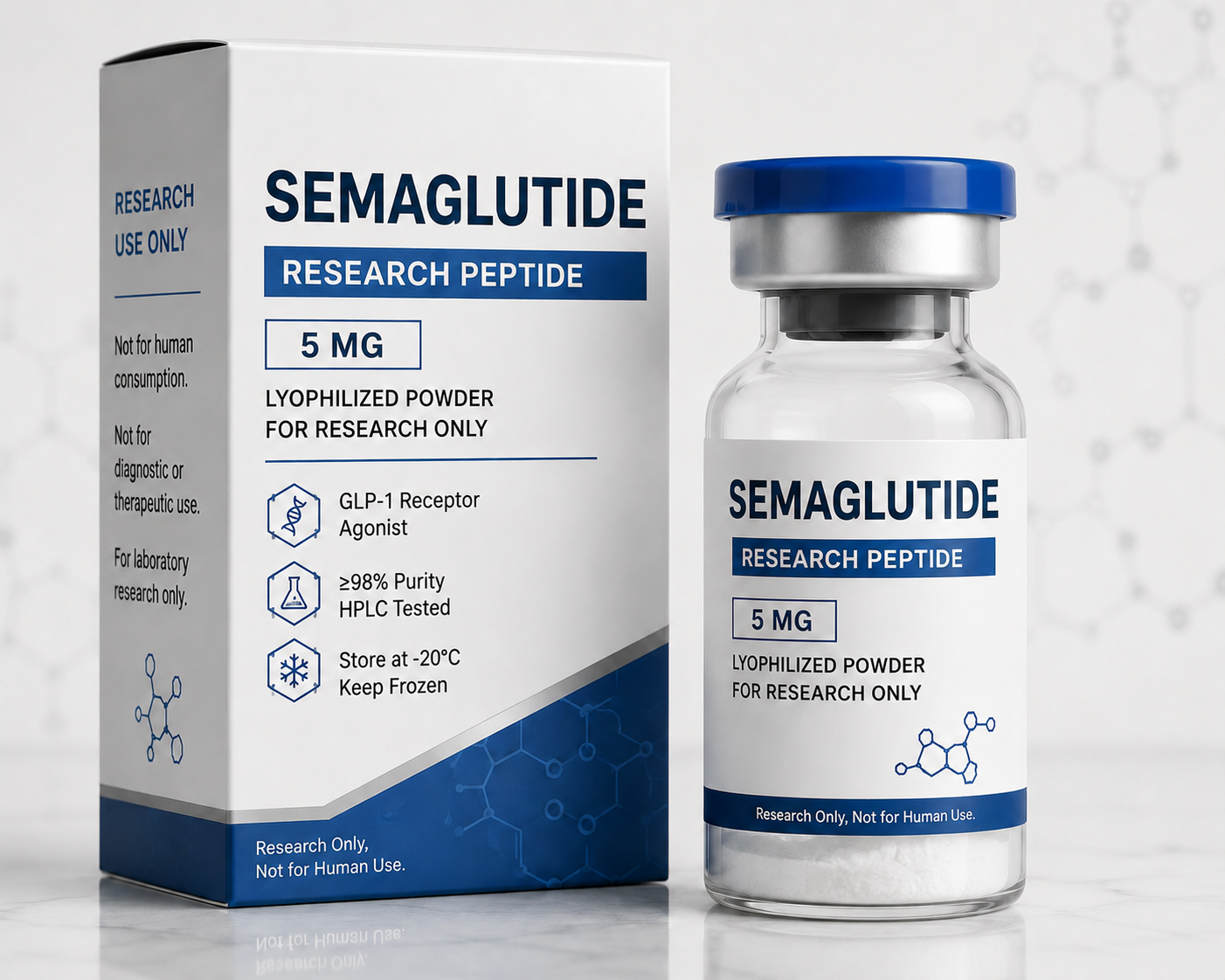
Quick Facts
PeptideValidation Insight: Semaglutide is a GLP-1 receptor agonist that has been extensively studied for its effects on appetite regulation, glucose metabolism, and weight management. It is being researched for its role in metabolic health, obesity management, and related metabolic conditions, with numerous clinical studies evaluating its long-term efficacy and safety.
About semaglutide
Semaglutide is a GLP-1 receptor agonist that mimics a naturally occurring hormone responsiblefor appetite regulation and blood sugar control.
It works by:
- Reducing hunger signals
- Increasing feelings of fullness.
- Slowing stomach emptying.
- Helping regulate blood glucose levels.
- Reducing calorie intake.
Unlike daily medications, Semaglutide is administered only once per week, making treatment easier for many patients.
Who May Benefit
- Adults with obesity (BMI ≥30)
- Adults overweight with related conditions
- Individuals struggling with appetite control
- Patients requiring long-term weight management support
Retatrutide Research Studies
Published clinical and preclinical research on Retatrutide.
Retatrutide 1 Trial
- 1,961 adults participated.
- Treatment duration: 68 weeks.
- Average weight loss: approximately 15%.
- Semaglutide significantly outperformed placebo.
Retatrutide 5 Trial
The longest weight-management trial to date evaluated patients over 104 weeks
Results:
- Average weight reduction: 15.2%.
- 77% of participants lost at least 5% of body weight.
- Weight loss remained sustainable over two years.
Retatrutide STEP UP Trial
Higher-dose semaglutide (7.2mg) demonstrated additional weight-loss benefits compared withthe currently approved 2.4mg dose.
- 1,407 participants
- 72-week treatment period.
- Significant improvements compared with placebo.
Retatrutide Cardiometabolic Benefits
Clinical studies have shown improvements in:
- Waist circumference
- Blood sugar levels
- Blood pressure
- Cardiovascular risk factors
- Metabolic health markers
🔑 Key Finding: Research continues to evaluate long-term cardiovascular benefits.
Comparisons
How does Retatrutide compare to other leading research peptides?
| Feature | Semaglutide | Tirzepatide | Liraglutide |
|---|---|---|---|
| Weekly Injection | Yes | Yes | Daily |
| Appetite Control | Excellent | Excellent | Moderate |
| Average Weight Loss | 15-17% | 20%+ | 6-8% |
| Dosing Frequency | Weekly | Weekly | Daily |
| Blood Sugar Support | Yes | Yes | Yes |
| Long-Term Data | Extensive | Growing | Established |
| Convenience | High | High | Moderate |
Tirzepatide vs Semaglutide
- Tirzepatide may produce greater weight loss due to its dual-agonist mechanism (GIP + GLP-1).
- Semaglutide currently has longer-term weight management data available.
- Both medications require physician supervision and dose titration.
Tirzepatide vs Liraglutide
- Tirzepatide requires only weekly injections, whereas Liraglutide requires daily administration.
- Tirzepatide produces vastly superior weight reduction (20%+ compared to Liraglutide's 6-8%).
Testing
Before starting Semaglutide, healthcare providers may evaluate:
Medical History
MH- Previous pancreatitis
- Gallbladder disease
- Thyroid disorders
- Family history of thyroid cancer
Laboratory Testing
LT- Blood glucose
- HbA1c
- Kidney function
- Liver function
- Lipid profile
Monitoring During Treatment
MDT- Weight changes
- Blood pressure
- Blood sugar levels
- Gastrointestinal symptoms
- Overall tolerance
Frequently Asked Questions
Everything you need to know about peptide testing, certification, and compliance.
Many patients notice appetite reduction within the first few weeks, while significant weight changes generally occur over several months.
Clinical trials reported average weight reductions of approximately 15% after long-term treatment.
No. It is administered once weekly.
Yes. The injection day may be changed if there are at least 48 hours between doses.
Yes. Unused pens should be stored between 2°C and 8°C.
Certified Vendor Requirements
To qualify as a PeptideValidation.com Certified Vendor, companies must meet our rigorous multi-step testing and documentation standards. Certification is not bought — it is earned through independent verification.
🏆 Apply for CertificationTo qualify, vendors must:
-
Submit Batch Testing
Vendors must submit product samples for independent third-party lab testing before listing.
-
Pass Purity Requirements
All products must meet minimum purity thresholds verified by HPLC analysis.
-
Verify Identity via LC-MS
Molecular identity of each compound confirmed through liquid chromatography-mass spectrometry.
-
Maintain Full Documentation
COAs, batch records, and testing documentation must be publicly available on the vendor profile.
-
Undergo Quarterly Re-Testing
Certification requires mandatory re-testing every quarter to maintain active certified status.
Looking for Certified Peptide Sources?
Access our directory of independently reviewed and tested vendors who meet our rigorous testing and validation standards.
PeptideValidation.com is an independent testing and certification platform. We do not sell peptides or receive commission from vendors.
Access Certified Vendor DirectoryRelated Peptides
Tirzepatide
GLP-1 + GIP dual receptor agonist. FDA approved for type 2 diabetes and obesity management.
Learn More → 🧬GLP-1 AgonistSemaglutide
Gold standard GLP-1 receptor agonist. Marketed as Ozempic and Wegovy globally.
Learn More → ⚡Amylin AnalogueCagrilintide
Long-acting amylin analogue in Phase 3 trials as a combination therapy with semaglutide.
Learn More → 🔥Dual AgonistSurvodutide
GLP-1 + Glucagon dual agonist by Boehringer Ingelheim currently in Phase 3 clinical trials.
Learn More → 🏋️Dual AgonistMazdutide
GLP-1 + Glucagon dual agonist showing strong metabolic and weight loss outcomes in trials.
Learn More → 🩺Healing PeptideBPC-157
Body Protection Compound. Researched for tissue repair, gut healing, and accelerated recovery.
Learn More → 💪Recovery PeptideTB-500
Thymosin Beta-4 fragment. Researched for muscle recovery, flexibility, and anti-inflammatory effects.
Learn More →