

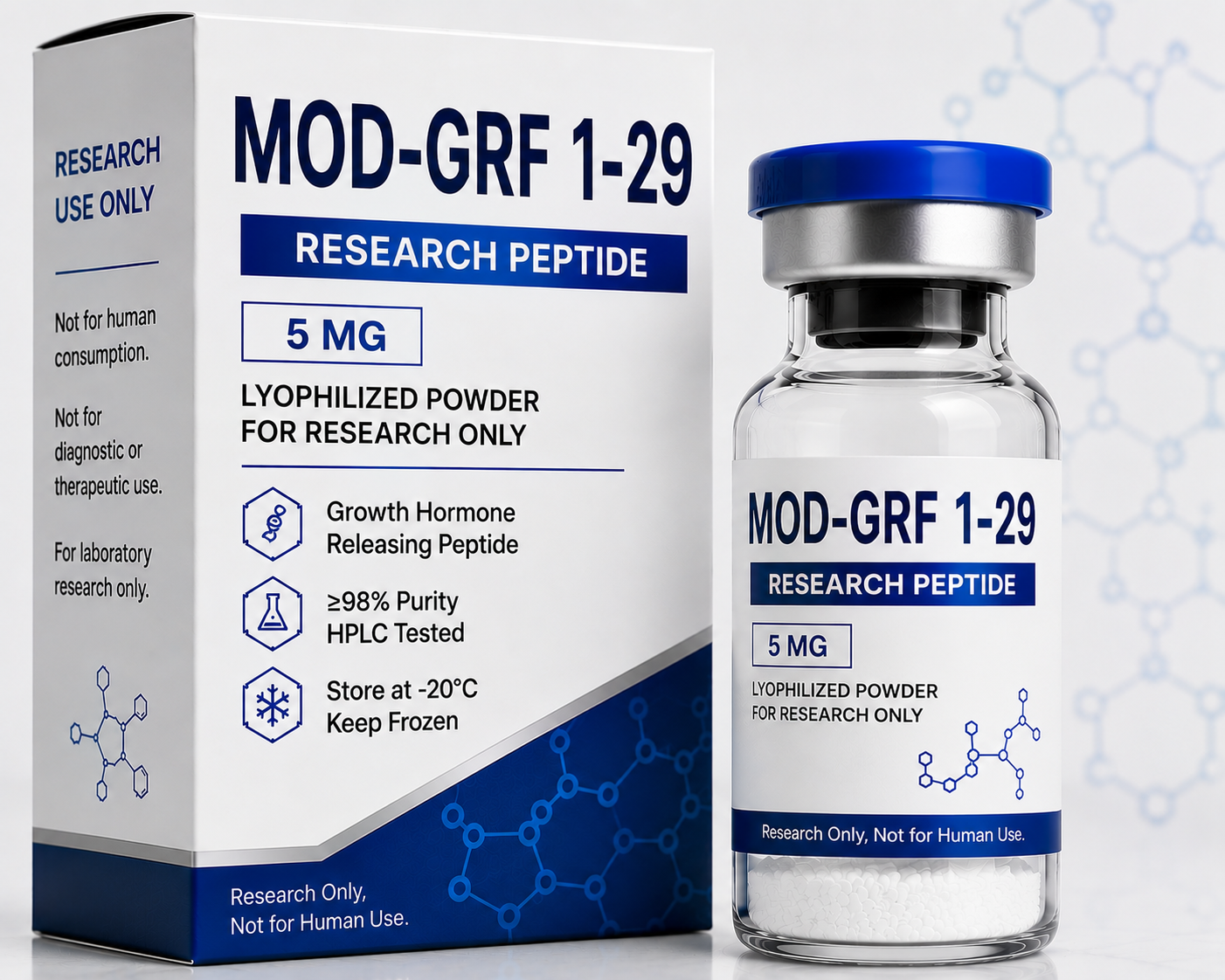
Quick Facts
MOD-GRF 1-29 (widely known as CJC-1295 Without DAC) is an advanced, synthetically modifiedGrowth Hormone Releasing Hormone (GHRH) analog. It is engineered to precisely stimulate thepituitary gland into secreting massive, physiological pulses of endogenous Human Growth Hormone(hGH). By perfectly mimicking the body's natural pulsatile rhythm, it drives profound muscularhypertrophy, rapid lipolysis (fat loss), advanced connective tissue repair, and deep neuro-restorativesleep, all while preserving the body's natural negative feedback loop.
What Is Retatrutide?
Retatrutide (LY3437943) is an investigational peptide that belongs to a class of compounds known as triple receptor agonists. It is designed to activate three key metabolic hormone receptors simultaneously: GLP-1 (glucagon-like peptide-1), GIP (glucose-dependent insulinotropic polypeptide), and glucagon receptors.Retatrutide is being studied in metabolic and obesity-related research because of its unique multi-receptor mechanism of action. Unlike traditional single-pathway compounds, Retatrutide targets multiple metabolic signaling pathways that researchers believe may influence appetite regulation, energy expenditure, glucose metabolism, and body weight.Developed by Eli Lilly and Company, Retatrutide has become one of the most widely discussed investigational peptides in metabolic research and is currently being evaluated in ongoing clinical studies. Retatrutide is a novel triple agonist peptide targeting the GLP-1, GIP, and glucagon receptors simultaneously.
Retatrutide (LY3437943) is a novel investigational peptide developed by Eli Lilly and Company. It is classified as a triple agonist, meaning it simultaneously activates three distinct hormone receptors: GLP-1 (glucagon-like peptide-1), GIP (glucose-dependent insulinotropic polypeptide), and glucagon receptors. This triple-receptor engagement sets Retatrutide apart from every other metabolic research peptide currently in development or on the market.
As of 2023, Retatrutide has demonstrated unprecedented weight loss outcomes in Phase 2 clinical trials, with participants achieving a mean body weight reduction of up to 24.2% over 48 weeks — making it the most effective weight loss compound ever tested in a randomized controlled trial at the time of publication.
How Does Retatrutide Work?
Retatrutide works by binding to and activating three key metabolic hormone receptors in the body. Each receptor plays a distinct role in energy metabolism, appetite regulation, and glucose homeostasis. By engaging all three simultaneously, Retatrutide creates a synergistic effect that exceeds what any single or dual agonist can achieve.
Why Was Retatrutide Developed?
Retatrutide was developed to address the limitations of first and second generation metabolic peptides. While semaglutide (GLP-1 only) and tirzepatide (GLP-1 + GIP) demonstrated significant efficacy, researchers hypothesized that adding glucagon receptor activity could further enhance energy expenditure through thermogenesis and hepatic fat reduction.
What Receptors Does It Target?
- GLP-1 Receptor — Controls insulin secretion, slows gastric emptying, and signals satiety to the brain
- GIP Receptor — Enhances insulin sensitivity, augments GLP-1 effects, and modulates lipid metabolism
- Glucagon Receptor — Increases energy expenditure via thermogenesis and reduces hepatic fat accumulation
How Is Retatrutide Different From Other Peptides?
- Only peptide in development targeting GLP-1, GIP AND glucagon simultaneously
- Highest weight loss outcomes ever recorded in a randomized controlled trial (24.2%)
- Significant reduction in liver fat — addressing NAFLD and metabolic liver disease
- Improvements in cardiometabolic markers including blood pressure and lipid profiles
- Once-weekly subcutaneous injection with a favorable tolerability profile
GLP-1 Receptor
Stimulates glucose-dependent insulin secretion, suppresses glucagon release, slows gastric emptying, and activates satiety pathways in the hypothalamus to reduce food intake.
GIP Receptor
Enhances glucose-stimulated insulin secretion, improves insulin sensitivity in peripheral tissues, augments GLP-1 activity, and modulates lipid metabolism and adipose tissue function.
Glucagon Receptor
Increases hepatic glucose production, stimulates thermogenesis and energy expenditure, promotes lipolysis, and directly reduces liver fat — a key differentiator from GLP-1/GIP dual agonists.
The simultaneous activation of all three receptors creates a synergistic metabolic effect that exceeds single-receptor targeting alone.
MOD-GRF 1-29 Research Studies
Published clinical and preclinical research on MOD-GRF 1-29 .
MOD-GRF 1-29 Massive IGF-1 Elevation
NEJM
Clinical studies measuring serum insulin-like growth factor 1 (IGF-1) demonstrate that regular administration of modified GHRH analogs can increase systemic IGF-1 levels by 200% to 300%. This massive anabolic spike is the primary driver of rapid muscular hypertrophy and connective tissue repair.
MOD-GRF 1-29 Preservation of Pulsatile Rhythm
Research confirms that MOD-GRF 1-29 successfully amplifies the amplitude of growth hormone pulses without disrupting the natural biological rhythm or elevating baseline trough levels. This 30- minute pulsatile clearance safely prevents the negative feedback loop that leads to pituitary shutdown.
MOD-GRF 1-29 Synergy with GHRPs (Ipamorelin)
Extensive endocrinology models prove that co-administering a GHRH (MOD-GRF 1-29) with a GHRP (like Ipamorelin or GHRP-2) yields an extreme synergistic response. The combination blocks somatostatin inhibitors while simultaneously stimulating the somatotrophs, resulting in a GH pulse magnitude up to 5x larger than singular administration.
🔑 Key Finding: 24.2% weight loss at highest dose.
Retatrutide vs Other Peptides
How does Retatrutide compare to other leading research peptides?
| Feature | Semaglutide | Tirzepatide | Liraglutide |
|---|---|---|---|
| Weekly Injection | Yes | Yes | Daily |
| Appetite Control | Excellent | Excellent | Moderate |
| Average Weight Loss | 15-17% | 20%+ | 6-8% |
| Dosing Frequency | Weekly | Weekly | Daily |
| Blood Sugar Support | Yes | Yes | Yes |
| Long-Term Data | Extensive | Growing | Established |
| Convenience | High | High | Moderate |
Tirzepatide vs Semaglutide
- Tirzepatide may produce greater weight loss due to its dual-agonist mechanism (GIP + GLP-1).
- Semaglutide currently has longer-term weight management data available.
- Both medications require physician supervision and dose titration.
Tirzepatide vs Liraglutide
- Tirzepatide requires only weekly injections, whereas Liraglutide requires daily administration.
- Tirzepatide produces vastly superior weight reduction (20%+ compared to Liraglutide's 6-8%).
PeptideValidation Testing & Validation
Every product undergoes rigorous multi-layer laboratory validation.
Medical History
MH- History of active malignancies or cancers (GH can potentially stimulate tumor growth if one is already present).
- Current status of insulin sensitivity and history of Type 2 Diabetes.
- Review of existing thyroid conditions, as elevated GH can influence thyroid conversion rates.
Laboratory Testing
LT- Baseline IGF-1 (Insulin-Like Growth Factor 1) levels to establish current growth hormone status.
- Fasting Blood Glucose and Hemoglobin A1c (HbA1c) to ensure healthy insulin sensitivity prio
- Comprehensive Thyroid Panel (TSH, Free T3, Free T4).
- Complete Blood Count (CBC) and Comprehensive Metabolic Panel (CMP).
Monitoring During Treatment
MDT- Follow-up IGF-1 testing 4 to 6 weeks into therapy to objectively measure pituitary response and titrate dosage.
- Monitoring of fasting glucose to ensure the lipolytic effects are not causing temporary insulin resistance
- Subjective tracking of sleep quality, joint mobility, muscle recovery, and overall vitality.
Frequently Asked Questions
Everything you need to know about peptide testing, certification, and compliance.
Yes. Chemically and molecularly, they are the exact same peptide. "MOD-GRF 1-29" is the accurate
scientific name for the 29-amino acid chain that has been tetrasubstituted for stability. "CJC-1295
Without DAC" is a misnomer created by the compounding community, but it remains the most
commonly used name in clinical practice.
To perfectly mimic the body's natural physiological rhythm, it is most commonly injected subcutaneously
once a day, right before bed. Because insulin heavily blunts the release of growth hormone, it is critical
that the injection is done in a fasted state—typically 2 to 3 hours after your last meal, ensuring your
blood sugar is low.
MOD-GRF 1-29 (a GHRH) and Ipamorelin (a GHRP) work on entirely different receptors. The GHRH
forces the pituitary to produce and release GH, while Ipamorelin shuts down the hormone
(Somatostatin) that normally stops GH release. Taking them together acts like pressing the gas pedal
and letting off the brake simultaneously, resulting in a massively amplified synergistic effect.
Improved, deeper sleep and enhanced vivid dreaming are usually noticed within the very first week.
Physical changes—such as increased muscle fullness, faster recovery from workouts, and noticeable
reductions in body fat—typically take 4 to 6 weeks to become highly visible, as profound tissue
remodeling requires biological time
Yes. Like all delicate peptide hormones, the lyophilized (freeze-dried) powder should be stored out of
direct light. Once reconstituted with bacteriostatic water, the vial must be kept in the refrigerator (2°C -
8°C) to maintain absolute stability and prevent the degradation of the amino acid sequence.
Certified Vendor Requirements
To qualify as a PeptideValidation.com Certified Vendor, companies must meet our rigorous multi-step testing and documentation standards. Certification is not bought — it is earned through independent verification.
🏆 Apply for CertificationTo qualify, vendors must:
-
Submit Batch Testing
Vendors must submit product samples for independent third-party lab testing before listing.
-
Pass Purity Requirements
All products must meet minimum purity thresholds verified by HPLC analysis.
-
Verify Identity via LC-MS
Molecular identity of each compound confirmed through liquid chromatography-mass spectrometry.
-
Maintain Full Documentation
COAs, batch records, and testing documentation must be publicly available on the vendor profile.
-
Undergo Quarterly Re-Testing
Certification requires mandatory re-testing every quarter to maintain active certified status.
Looking for Certified Peptide Sources?
Access our directory of independently reviewed and tested vendors who meet our rigorous testing and validation standards.
PeptideValidation.com is an independent testing and certification platform. We do not sell peptides or receive commission from vendors.
Access Certified Vendor DirectoryRelated Peptides
Tirzepatide
GLP-1 + GIP dual receptor agonist. FDA approved for type 2 diabetes and obesity management.
Learn More → 🧬GLP-1 AgonistSemaglutide
Gold standard GLP-1 receptor agonist. Marketed as Ozempic and Wegovy globally.
Learn More → ⚡Amylin AnalogueCagrilintide
Long-acting amylin analogue in Phase 3 trials as a combination therapy with semaglutide.
Learn More → 🔥Dual AgonistSurvodutide
GLP-1 + Glucagon dual agonist by Boehringer Ingelheim currently in Phase 3 clinical trials.
Learn More → 🏋️Dual AgonistMazdutide
GLP-1 + Glucagon dual agonist showing strong metabolic and weight loss outcomes in trials.
Learn More → 🩺Healing PeptideBPC-157
Body Protection Compound. Researched for tissue repair, gut healing, and accelerated recovery.
Learn More → 💪Recovery PeptideTB-500
Thymosin Beta-4 fragment. Researched for muscle recovery, flexibility, and anti-inflammatory effects.
Learn More →